一句话定位:这是一篇用脑功能成像(PET/fMRI)重新检验"语言定位"这一百年问题的综述。Price 把 19 世纪的神经解剖模型与 20 世纪的认知模型放在同一套影像学证据面前,逐区裁决:韦尼克区的功能其实在颞上沟后部上岸、发音规划的关键部位是前岛叶而非布罗卡区,而 19 世纪解剖学家漏掉的左后下颞叶恰恰是认知模型所预言的"第二条阅读通路"。文章最后给出一个被解剖约束的新词加工模型。
研究背景
语言定位的故事从 19 世纪开始:Broca(1861)据一例尸检把左侧第三额回与言语的运动表象联系起来(后称布罗卡区);Wernicke(1874)把左颞上回后部与言语的听觉表象联系起来(后称韦尼克区);Wernicke 进一步预言,若连接两区的白质束(弓状束,arcuate fasciculus)受损,患者理解与说话完好却无法复述——这种传导性失语(conduction aphasia)由 Lichtheim(1885)首次报告。阅读方面,Dejerine(1891、1892)区分了伴失写的失读(损伤左侧角回,角回因此被绑定到"视觉词形"记忆)与不伴失写的纯失读(左枕叶与胼胝体压部损伤,角回与视皮层失连接);Geschwind(1965)把这条通路补进模型:视皮层→角回→韦尼克区→言语输出。
但病灶—缺陷模型的解释力有硬伤:患者神经心理学画像常含多个认知缺陷,认知重组与神经重组会掩盖缺陷全貌;病理性损伤很少恰好落在功能同质的系统上,有些脑区(如下文将出现的左后下颞叶)因血供双重来源而"对缺血相对免疫";而且从病灶研究只能得出必要性的结论——无法断言受损区对该功能是充分的或唯一对应的。20 世纪认知科学家干脆放弃解剖,纯靠行为数据发展出精细的"框与箭头"模型:Patterson 与 Shewell(1987)的模型含四个词典(听觉输入、正字法输入、听觉输出、正字法输出)与多条阅读通路,其依据是表层失读(surface dyslexia,能读无意义的生造词如 LONT、读不出不规则拼写词 DEBT)与语音性失读(phonological dyslexia,情况恰好相反)的双分离(Marshall 与 Newcombe,1973)——这显出 19 世纪模型的不够用;连接主义/并行分布式模型(Seidenberg 与 McClelland,1989)则把四个词典化约为正字法、语音、语义三套表征之间的交互。缺口由此清晰:认知模型不受神经解剖约束,神经模型解释不了认知精细性。
研究思路
Price 的总策略是"用功能成像当裁判":功能成像在正常被试上无损地显示"完成一个任务相对另一个任务是充分的"这一整套脑区系统,恰好与病灶研究的"必要性"结论互补——两者合起来才够裁决模型。方法上采用扣减法(subtraction methodology):用激活任务对比不含目标加工的基线任务,逐级剥离。作者对扣减法的两个局限保持清醒:其一,语言系统对任何词形刺激高度敏感,基线任务中难以避免隐性(implicit)词加工,很难找到只差目标加工的两个任务;其二,即使感觉输入匹配,激活也会随任务要求变化(如朗读与默读同一批词时视觉区激活不同)。因此综述的证据链是层级化的对比设计:从静息,到听觉/视觉输入,到言语输出,到词提取,再到语义——每一层都设法用"念 Okay""看假字"等基线控制注意、发音、言语生成与自听反馈,再在阅读与复述之间直接对比,并把成像的"充分性"与病灶的"必要性"并置裁决各区的功能归属。
方法
这是一篇综述而非单一实验,其"方法"由两部分构成。其一为成像手段:文中汇总的激活数据来自正电子发射断层扫描(positron emission tomography, PET,测量局部脑血流)与功能磁共振(fMRI,测量脱氧血红蛋白变化),两者都通过探测神经活动伴随的血液成分与血流变化来间接测量神经活动;同一张图常并置多个独立研究的对比。其二为对比范式族:听词对比信号相关噪声(分离言语输入);复述对比被动听词(分离言语输出的感觉运动成分);复述对比"听同样的词并说 Okay"(部分控制对词的注意、发音、言语生成与自听);默读对比视觉复杂度匹配的假字母串(控制字母的视觉特征);朗读对比默读、朗读对比命名环境声或图片命名(分离词汇—语义性的词提取);以及一个两步扣减——先分别求"言语复述对匹配噪声"与"环境声命名对噪声"的激活,再把两者相减,以控制词与声音在时长、振幅、平均频率上的差异。文中另附一张术语表界定音位、字位、正字法、四个词典与语义记忆等概念。必要性的裁决则引用病灶与电刺激文献(如词聋、经皮质感觉性失语、命名缺失的病例报道)。
主要结果
- 复述与朗读对静息的激活大体符合 19 世纪模型,但有三处系统性出入(图 5):听词复述激活初级听皮层、韦尼克区、布罗卡区后部(岛盖部)与腹侧运动皮层,朗读另有视皮层激活;然而朗读并未激活角回,反而一致激活左后下颞叶(中梭状回)皮层;布罗卡区的激活仅限于岛盖部、无三角部;且整个系统呈双侧而非左侧化。
- 言语输入与输出可以分解(图 6、7):言语输入激活双侧颞上、中回(词聋患者的双侧颞上回病灶提示这些区域承担言语特有的听觉感知);输出时左侧颞上沟后部激活增强,发音规划落在左前岛叶(与 Dronkers 1996 的病灶证据一致),双侧岛盖感觉运动皮层承担发音运动控制。朗读与复述激活的输出区域几乎逐一重合(两图第二行来自不同被试组),证实两者共用一个言语输出系统,与两代模型的共同预言一致。
- 左后下颞叶是模态无关的词提取区,补上了"第二条阅读通路"(图 9):跨视觉词、图片、字母、颜色、盲文、听觉与自发生词等一系列命名/提取任务,左后下颞梭状回区与额叶岛盖/前岛叶一致激活;两例近期病灶研究显示该区离散损伤导致命名缺失(anomia)而物体识别、语义与复述完好。由于该区血供来自大脑后与中动脉双重来源、少见选择性梗死,19 世纪神经学家漏掉它有了自然解释。把该区放进模型后,阅读有了两条通路:经韦尼克区的非语义通路与经左下颞叶的语义通路——病灶分布(表层失读伴左下颞损伤、语音性失读伴更靠上并延伸至缘上回的损伤)与之吻合。
- 角回属于分布式语义系统而非视觉词形系统(图 10、11):当词义可用时(复述真词对无意义音节、朗读真词对假词、读名人与物体名对辅音串、语义判断对音节判断),左侧后颞—顶交界(含角回)与左前下颞叶一致激活;该结论得到病灶(角回损伤致书面与口语理解障碍、语义性痴呆)与皮层记录的支持。语义系统内部还有细分:左后中颞回对物体与身体部位名更活跃(可能伴随动作提取),前下颞叶对名人名与更具体的语义属性更活跃,中梭状回(BA20)是跨模态的语义属性区,而需要生成词联想时前布罗卡区被招募——它是句子生成的必要一环,却非单词朗读/复述所必需。
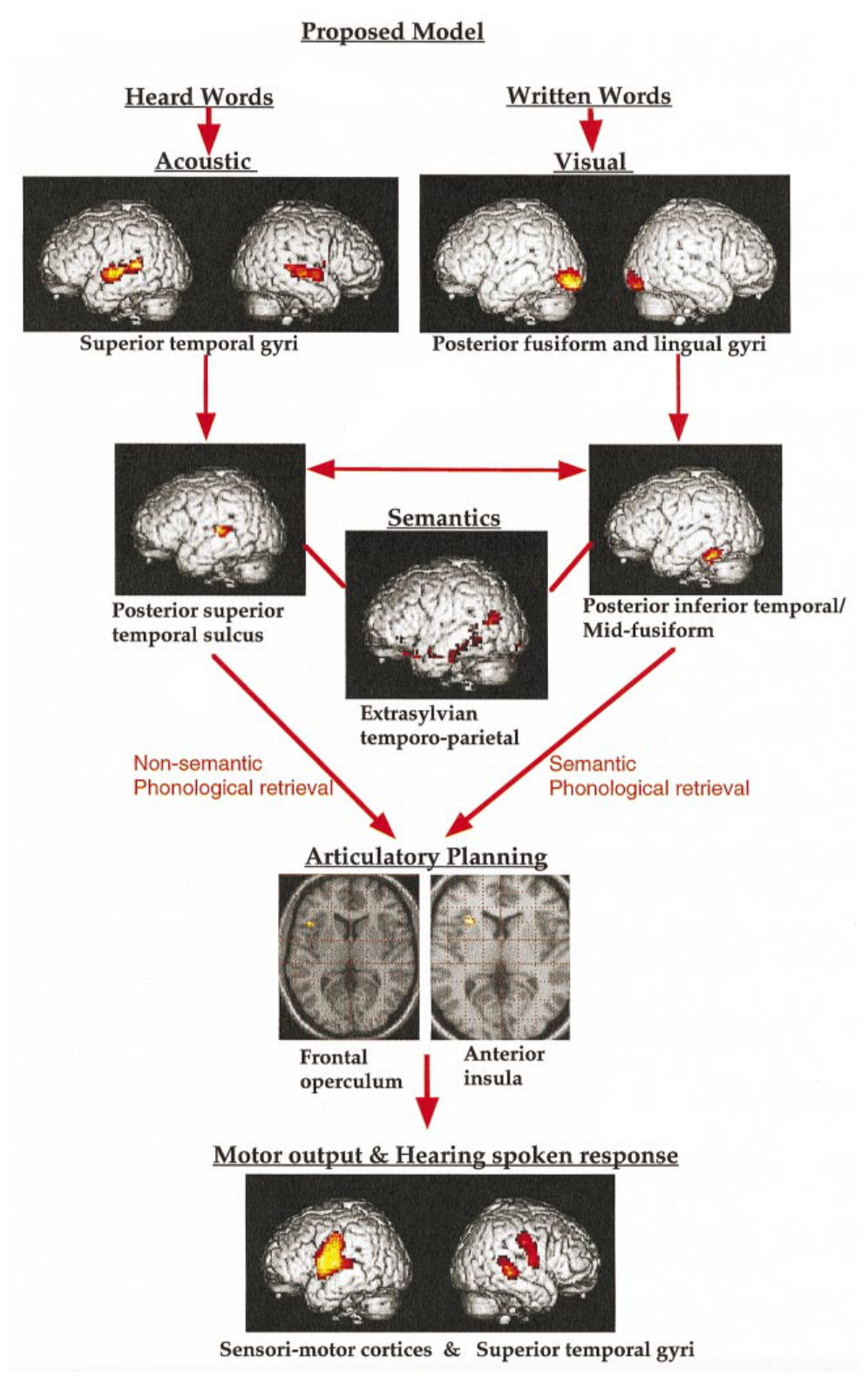
- 整合成新模型(图 12):听词的听觉加工在双侧颞上回;词义分布于左后中颞、后颞顶与前下颞叶;要求言语输出时,颞上沟后部(承担非语义介导的输出,命名图片时不增强)与左后下颞叶(承担词汇—语义介导的提取)分别增强,两者都与前岛叶/额叶岛盖的发音规划整合;运动控制落在双侧感觉运动皮层。书面词激活同一套区域,外加并不特属于阅读的后梭状回与舌回——阅读特异之处在于视皮层与颞上沟后部激活的"共现",即功能整合。
图注解读
图 1 · 19 世纪神经解剖模型
Fig. 1. The anatomy of the 19th century neurological model of language. The upper panel illustrates the anatomical location of the primary auditory cortex (PAC), Wernicke's area, the arcuate fasciculus, Broca's area and the motor cortex. The lower panel also includes the visual cortex and the angular gyrus for reading (see Geshwind, 1965).
上下两个面板画出经典模型的全套解剖件:上面板是初级听皮层(PAC)、韦尼克区、弓状束、布罗卡区与运动皮层,构成"听—理解—说"的通路;下面板为阅读补充视皮层与角回(按 Geschwind 1965 的整理)。这张图是全文的靶子:后面图 5 至图 8 的成像数据都要与它对照,裁决哪些定位站得住、哪些需要修正。
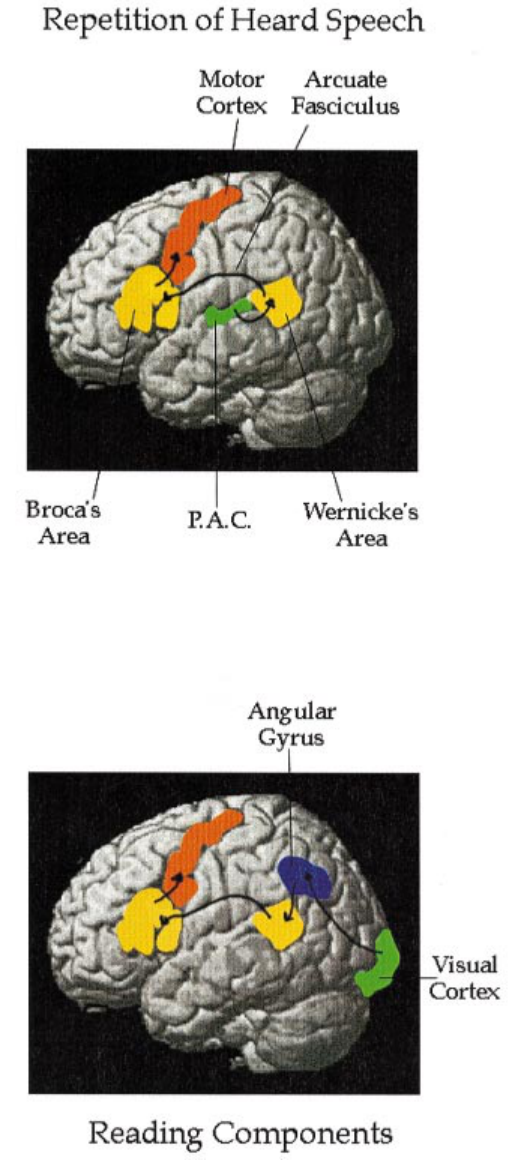
图 2 · 19 世纪模型的认知成分
Fig. 2. The cognitive components of the 19th century neurological model. According to Lichtheim (1885), the sequence of cognitive events for spoken word processing involves access to 'auditory word representations' (in Wernicke's area), the concept centre (for the meaning of words) and motor word representations of speech (in Wernicke's area). For written word processing, access to visual word representations (in the angular gyrus) feeds into auditory word representations (in Wernicke's area; see Geshwind, 1965).
这张框图按 Lichtheim(1885)的表述给出模型的心理组件:口语词加工依次经过"听觉词表征"(置于韦尼克区)、"概念中心"(词义)与言语的"运动词表征";书面词加工则由"视觉词表征"(置于角回)汇入听觉词表征。它把图 1 的解剖区一一赋予认知角色,是后文图 12 新模型逐项对账的对象——尤其是"视觉词表征在角回"这条,将被成像数据推翻。
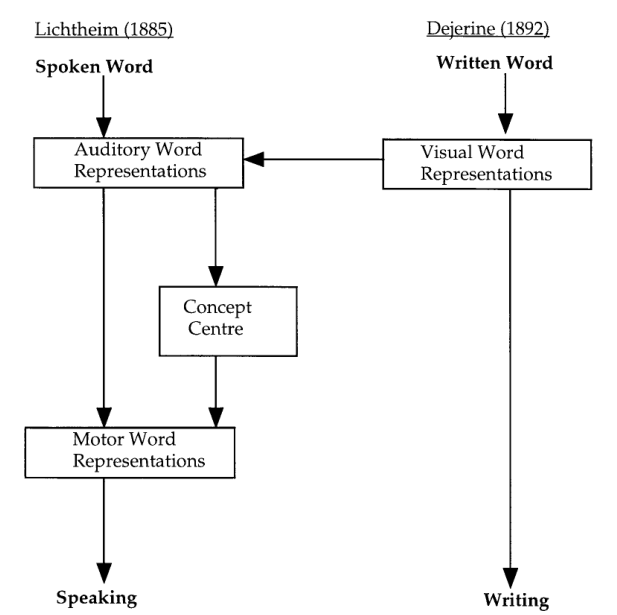
图 3 · 20 世纪框—箭头认知模型
Fig. 3. A 20th century cognitive model of word processing. Cognitive model proposed by Patterson & Shewell (1987). The terminology is defined in the Table. The key components involve 4 distinct lexicons. The auditory input lexicon corresponds to the auditory images of speech. The orthographic input lexicon corresponds to the visual images of words. The auditory output lexicon corresponds to the motor images of speech. The orthographic output lexicon is not specified in the neurological model but specifies the motor images for writing. The cognitive system includes the concepts of words. Another important element of the model is that it incorporates more than one route for reading and speaking. For instance, words can either be read via orthographic analysis, the orthographic input lexicon and the phonological output lexicon or by direct links between orthographic analysis and a response buffer (sublexical level orthographic to phonological conversion).
Patterson 与 Shewell(1987)的单词加工模型:左半是听与说、右半是读与写,核心是四个词典(听觉输入、正字法输入、听觉输出、正字法输出,最后一项在神经模型中并无对应)加上概念系统。关键之处在于阅读与说话各有多条通路——既可经正字法分析、正字法输入词典与语音输出词典的"词汇"路线,也可由正字法分析直连反应缓冲器的"亚词汇"路线。这条多通路设定,正是表层与语音性失读双分离所要求的,也是 19 世纪模型无法容纳的。
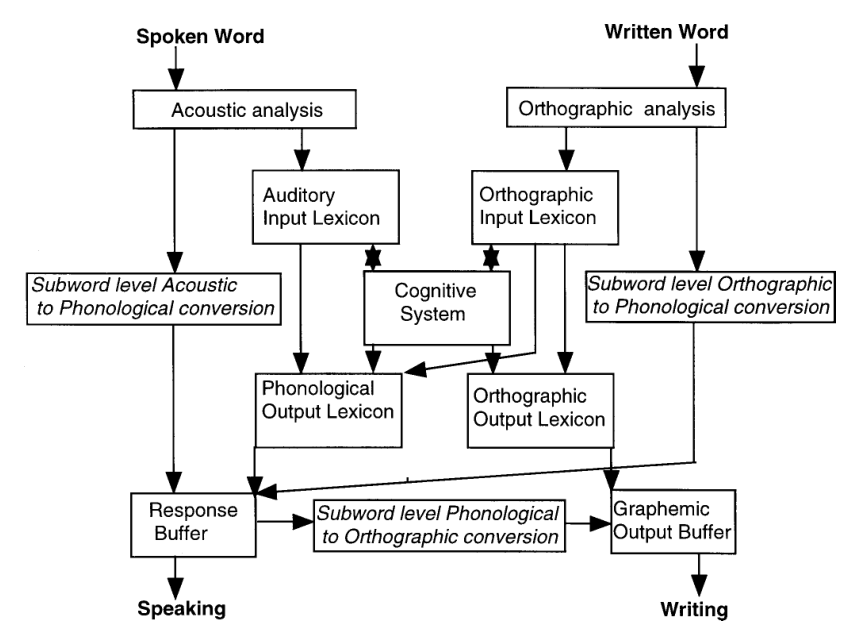
图 4 · 连接主义模型
Fig. 4. A connectionist model of word processing. In this connectionist model adapted from Seidenberg & McClelland (1989), there are no separate input and output modules for phonology and orthography and the 4 input and output lexicons specified in Figure 3 are replaced by connections/interactions between phonology and semantics (P-S and S-P), semantics and orthography (O-S and S-O) and orthography and phonology (O-P and P-O). Retrieving the phonology (P) of seen words from orthography (O) can either occur via direct links (O-P) or indirectly via semantics (O-S, S-P).
连接主义的对照方案:语音、语义、正字法之间没有独立的输入/输出模块,图 3 的四个词典被 P-S、S-P、O-S、S-O、O-P、P-O 六组连接所取代;看见的词要取回语音,可以走 O-P 直连,也可以绕道语义(O-S、S-P)。它与图 3 代表了认知模型的两极——模块化与交互式——Price 想检验的是:无论哪种极,成像数据支持到什么程度。
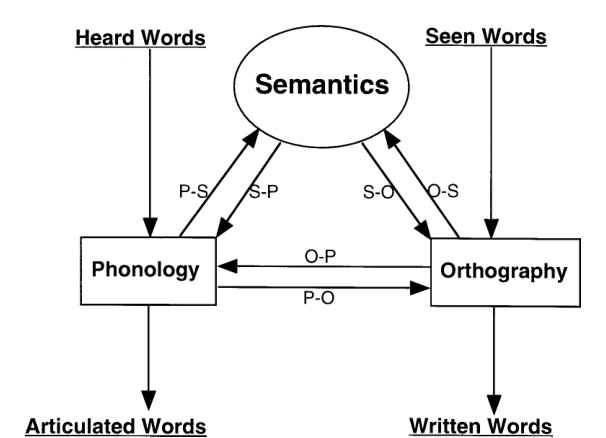
图 5 · 复述与朗读对静息的全脑激活
Fig. 5. The neural systems for auditory and visual word repetition. Brain areas activated (in red and yellow). At top: repeating heard words relative to rest (data from McCrory et al. 2000); middle: reading aloud relative to rest (data from Price et al. 1996b); and bottom: reading aloud relative to articulating the sounds of words without generating any sound (data from Price et al. 1996c).
三行脑表面渲染图(红黄为激活区):上行是复述听词对静息,中行是朗读对静息,下行是朗读对比"只做无声发音"。上行、中行显示的激活与图 1 的 19 世纪模型高度吻合——初级听皮层、韦尼克区、布罗卡区岛盖部、腹侧运动皮层,朗读再加视皮层;下行则解释了一个细节:朗读时初级听皮层也激活,因为被试听到了自己的声音(对比无声发音即可见)。更重要的是图上看不出来的三处"不符合":朗读对静息不激活角回、却激活左后下颞叶中梭状回;布罗卡区激活只限岛盖部;系统是双侧的。这张图确立了"大体吻合、局部出入"的总基调,引出后面对角回、左后下颞叶与三角部的专项追查。
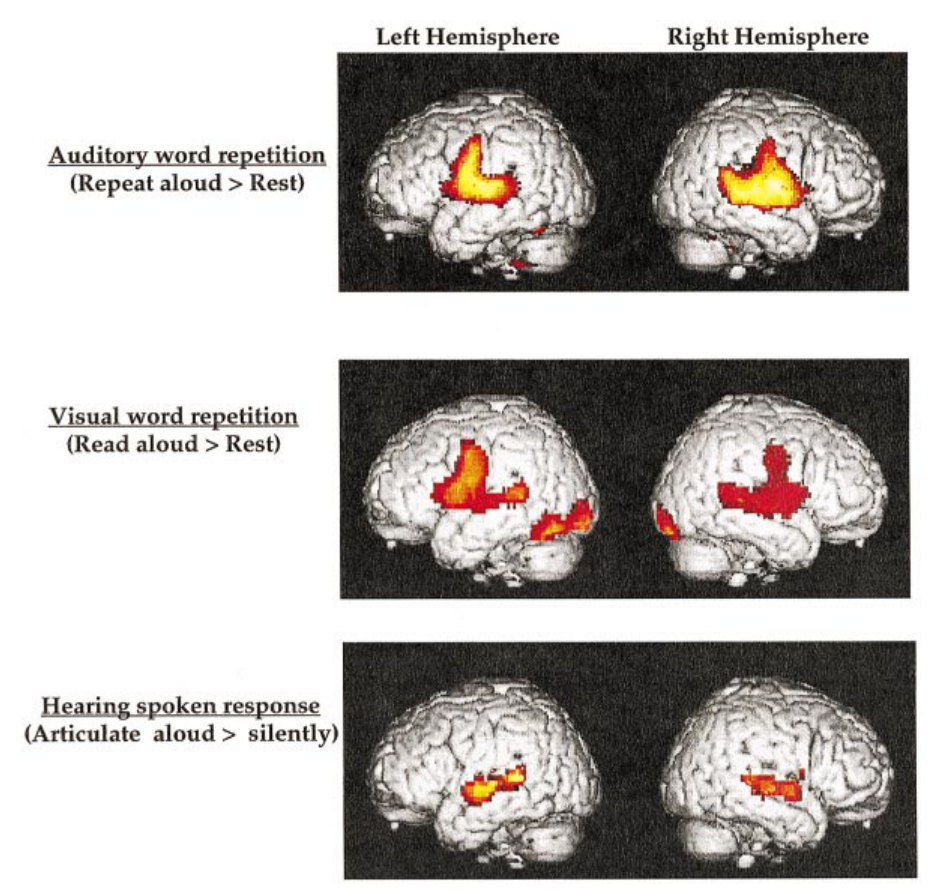
图 6 · 听词复述的解剖成分分解
Fig. 6. The anatomical components of heard word repetition. Brain areas activated (in red and yellow). At top: listening to words relative to signal correlated noise equivalents (data from Mummery et al. 1999); second row: repeating words aloud relative to listening to words at the same rate (data from Price et al. 1996b); third row: repeating heard words aloud relative to listening to the same words and saying 'Okay' (data from A. L. Giraud & C. J. Price, unpublished); fourth row: transverse sections to show the precise anatomical location of the activation in the third and fifth rows; fifth row: repeating heard words aloud relative to naming environmental sounds after acoustic differences have been controlled (data from A. L. Giraud & C. J. Price, unpublished).
五行对比把"复述"拆开:第一行(听词对信号相关噪声)给出言语输入系统——双侧颞上回前后部(含 Heschl 回)、平面颞叶、颞上沟与颞中回;第二行(复述对等速听词)给出输出相关激活——双侧岛盖感觉运动皮层(延伸超过联合线 20 mm,与呼吸的自主控制有关)、左额岛盖,以及右侧颞上回后部;第三行(复述对"听词+说 Okay")是关键一招,"Okay"控制了注意、发音、言语生成与自听四个因素,结果成功把左前岛叶从周围运动与下额皮层中分离出来(第四行横断面精确定位),同时在左后下颞叶与小脑交界处出现激活;第五行(声学差异控制后复述对环境声命名)显示言语特异区在左颞上沟后部上岸(韦尼克区的下部)及右侧同源区。支撑结果 2 与结果 3 的核心证据都在这张图里。
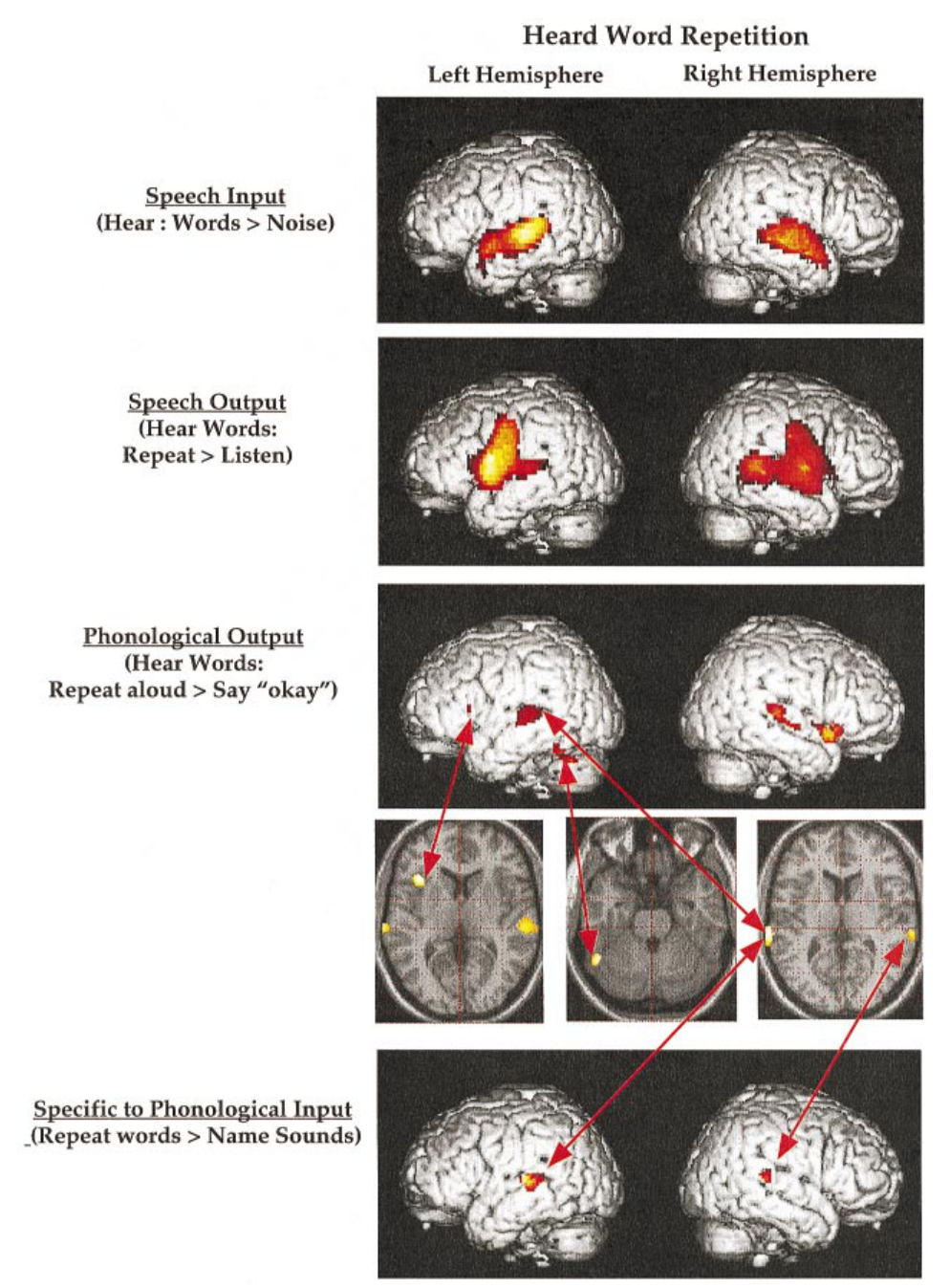
图 7 · 阅读的解剖成分分解
Fig. 7. The anatomical components of reading. Brain areas activated (in red and yellow). At top: viewing words silently relative to viewing falsefonts matched for visual complexity (data from Brunswick et al. 1999); second row: reading aloud relative to reading silently (data from Price et al. 1996b); third row: reading aloud relative to viewing the same words and saying 'Okay' (data from Moore & Price, 1999); fourth row: transverse sections to show the precise anatomical location of the activation in the third and fifth rows; fifth row: reading aloud relative to picture naming after visual differences have been controlled (data from Moore & Price, 1999).
版式与图 6 一一对应,对象换成阅读:第一行(默读对视觉复杂度匹配的假字)显示默读激活左后下颞叶(中梭状回)、左颞上回后部与小脑;第二行(朗读对默读)激活的区域与图 6 第二行完全对应(两研究用了不同被试组),证实复述与朗读共用一个言语输出系统;第三行(朗读对"看词+说 Okay")激活左后下颞叶、左前岛叶与左颞上沟,与听词的语音输出系统几乎重合(第四行横断面佐证);第五行(视觉差异控制后朗读对图片命名)显示左颞上回后部对阅读更活跃、并向顶叶延伸——而图片命名必须经过语义,阅读却可以不走语义(如读生造词 Dobocodoo),这为"韦尼克区承担非语义阅读通路"提供了证据。图中另可见舌回激活,作者讨论其并非词特异(命名物体也激活,可能与命名要求下的整体形状注意有关)。
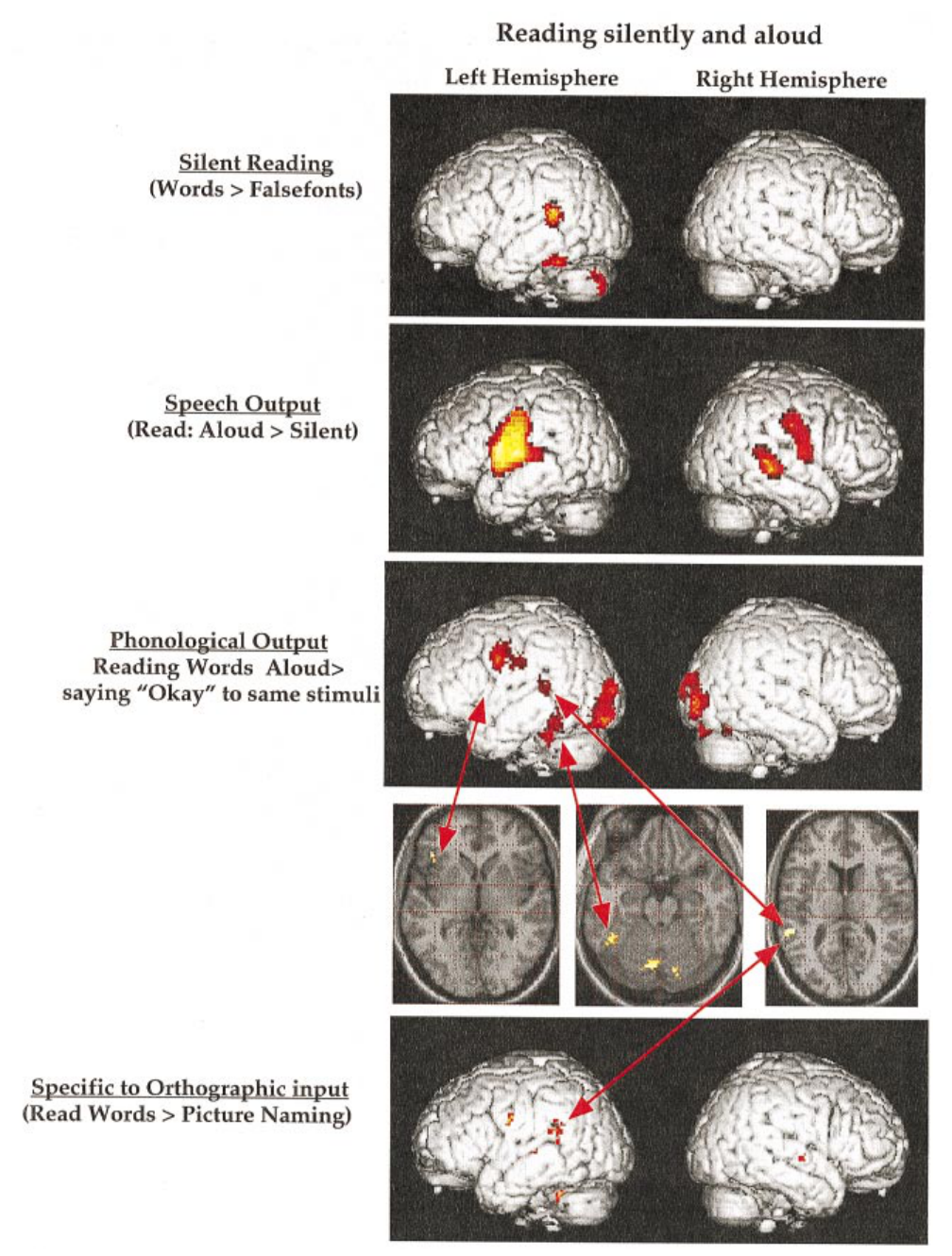
图 8 · 阅读与复述的异同直接对比
Fig. 8. Similarities and differences between the anatomy of reading and repetition. Brain areas activated (in red and yellow). At top: repeating heard words aloud relative to listening to the same words and saying 'Okay' (data from A. L. Giraud & C. J. Price, unpublished) and also reading aloud relative to viewing the same words and saying 'Okay' (data from Moore & Price, 1999); second row: areas more active for repeating; third row: areas more active for reading by contrasting data from Moore & Price, (1999) with A. L. Giraud & C. J. Price (unpublished) using standard methodology.
把图 6、7 第三行的数据正面相撞:顶行是两个"各自对 Okay 基线"的对比,共有的激活落在左后下颞叶与左颞上沟后部(韦尼克区)——两模态的词输入都能进入这两个区,但 PET 的空间分辨率不能排除共享区内部仍有听觉/视觉的特化(例如阅读与命名对比的激活比复述与环境声命名对比高 8 mm,已在分辨率之外);第二行是复述更活跃的区域——双侧听皮层(含韦尼克区),因为刺激特异的语音必须发音时听觉加工增强;第三行是阅读更活跃的区域——左后下颞叶,外加左内侧外纹状视皮层(嵌入小图,物体命名亦见、复述不见)。这张图把"两条通路"从并存升级为竞争性偏置:复述偏重颞上侧,阅读偏重下颞侧。
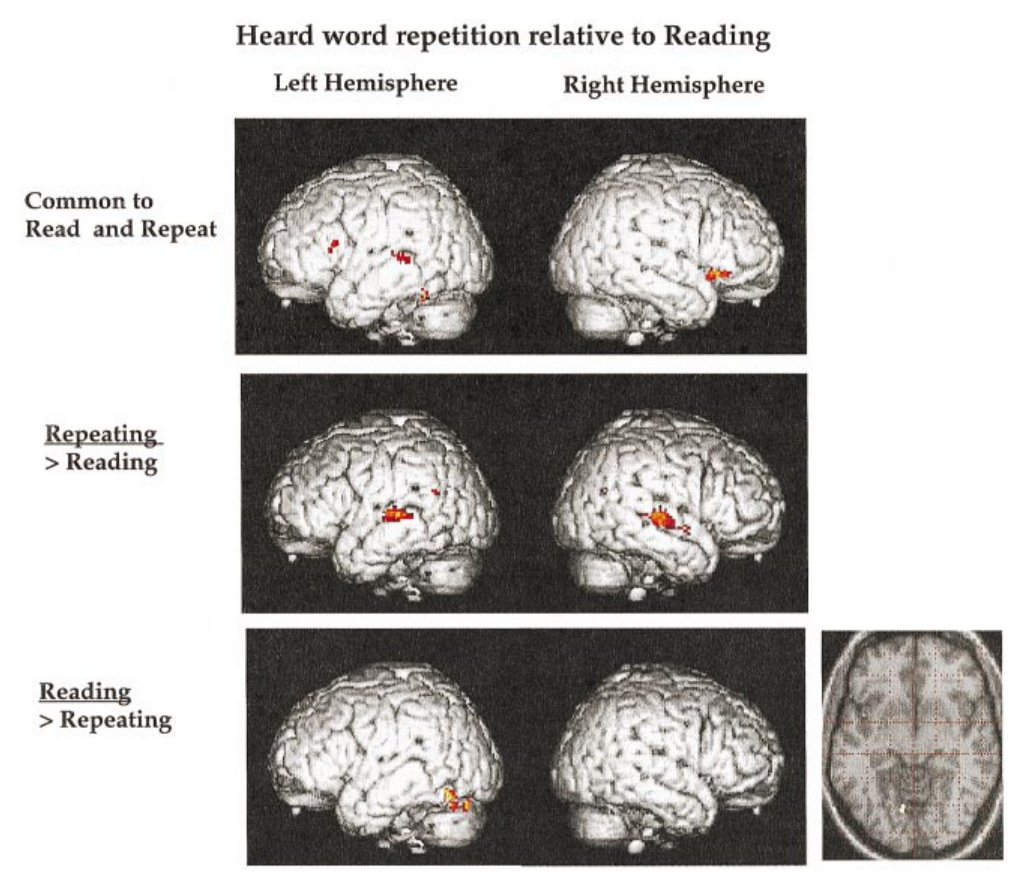
图 9 · 模态无关的词提取系统
Fig. 9. Modality independent word retrieval. Areas of the brain that activate during name retrieval are illustrated in red and yellow on renderings of the left side of the brain only. Top row: naming visual words (reading) contrasted with viewing strings of falsefont and saying 'Okay' (data from Moore & Price, 1999), naming visual pictures contrasted with viewing nonsense figures and saying 'Okay' (data from Moore & Price, 1999); naming visual letters contrasted with viewing single falsefont and saying 'Yes'; and naming the colour of meaningless shapes contrasted with viewing the same coloured shapes and saying 'Okay' (data from Price & Friston, 1997b); second row: naming tactile words (reading braille) contrasted with feeling consonant letter strings in braille (data from Buechel et al. 1998); auditory word repetition and environmental sound naming contrasted to hearing signal correlated noise and saying 'Okay' (data from A. L. Giraud & C. J. Price unpublished); self generated words related to auditorily presented letters (e.g. hear 'H' say 'House') contrasted with auditory repetition of the same letters (data from Frith et al. 1991a). Third and fourth rows: areas common to all studies illustrated; these include the posterior inferior temporal cortex in the fusiform gyrus, the posterior inferior frontal cortex, the frontal operculum (for all tasks except letter and colour naming) and the anterior insula for the visual tasks only.
七种提取任务的"认知联合"(cognitive conjunction)汇总:读视觉词、命名图片、命名字母、命名颜色、读盲文、复述与命名环境声、听字母自发联想词。第三、四行给出所有研究的共同激活:梭状回内的后下颞皮层、后下额皮层与额叶岛盖(字母与颜色命名除外)、以及仅视觉任务出现的前岛叶。这正是结果 3 的图形证据——左后下颞叶的激活不挑输入模态,属于"词提取"本身;结合两例"该区离散损伤致命名缺失而其余完好"的病灶报道,它在功能等级中的位置(语义介导的词提取,且为必要)便立住了。
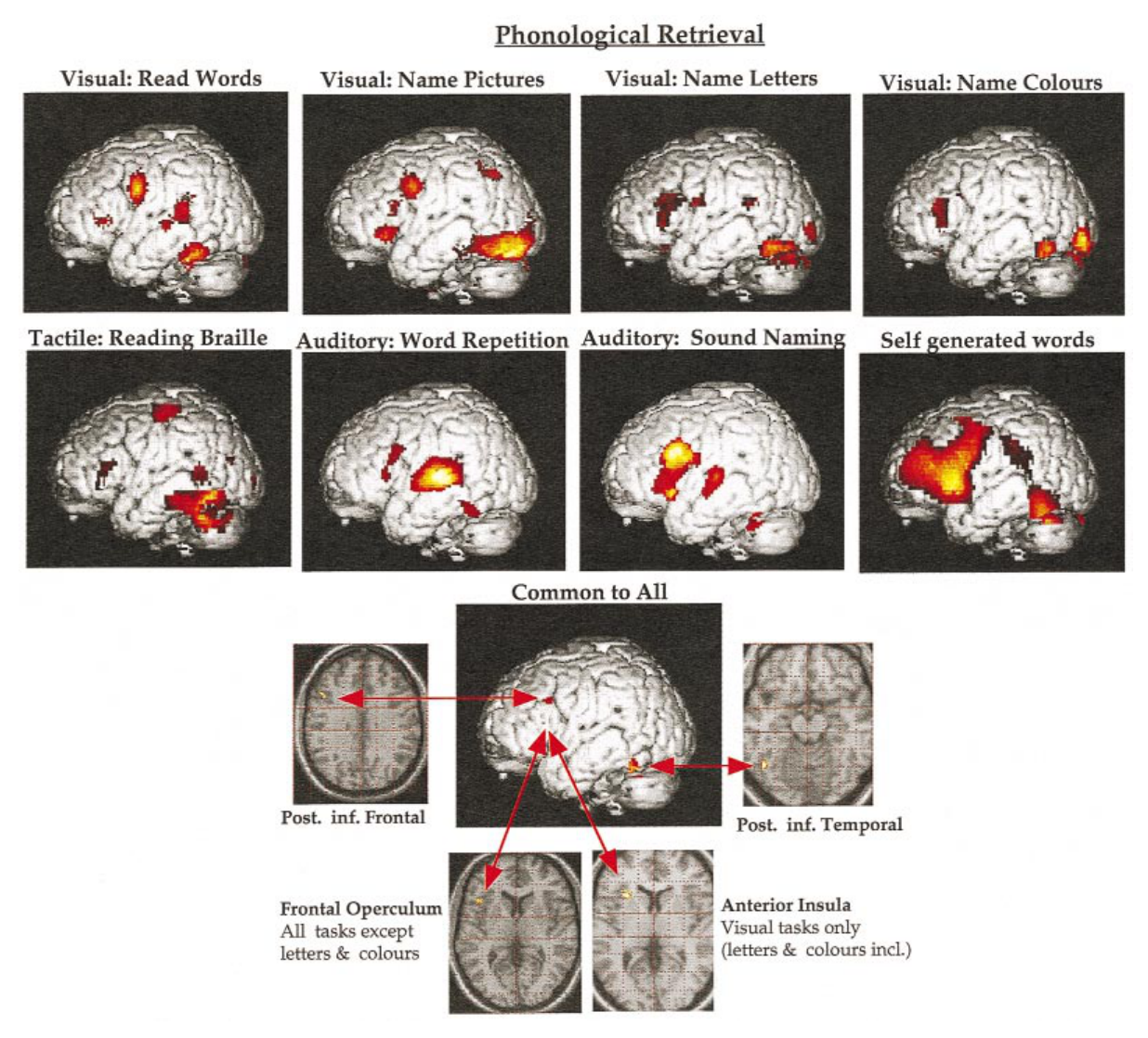
图 10 · 词义的脑区分布
Fig. 10. The meaning of words. Areas of the brain that activate when the meaning of words is available are illustrated in red and yellow on renderings of the left and right side of the brain. Top row: repeating words relative to repeating meaningless syllables (e.g. tatata); data from A. L. Giraud and C. J. Price (unpublished). Second row: reading aloud real words relative to reading meaningless pseudowords (e.g. LONT); data from Brunswick et al. (1999). Third row: reading the names of famous people (e.g. 'MARILYN MONROE') and objects (e.g. 'WHEEL BARROW') relative to strings of consonant strings ('MNRTRBNMTTRW'); data from Gorno-Tempini et al. (1998). Fourth row: semantic decisions (is it a living item?) on written words (e.g. 'TABLE' or 'PIG') relative to syllable decisions (does it have 2 syllables?) on the same words; data from Price et al. (1997b). On the right of each row, a transverse slice 20 mm below the intercommisural line illustrates the precise locations of the anterior inferior temporal activations.
四种"有义对无义"的对比:复述真词对复述无意义音节(tatata)、朗读真词对假词(LONT)、读名人与物体名对辅音串、书面词的语义判断(是否生物)对音节判断。四行一致激活的是左侧后颞—顶交界与左前下颞叶(右侧每行的横断面切片标出前下颞激活的精确位置)。这一致性把"角回+前下颞叶"绑定到语义加工上,支撑结果 4;同时右侧切片也暴露出各研究激活位置的漂移,为下一张图"语义属性分区"的问题埋下伏笔。
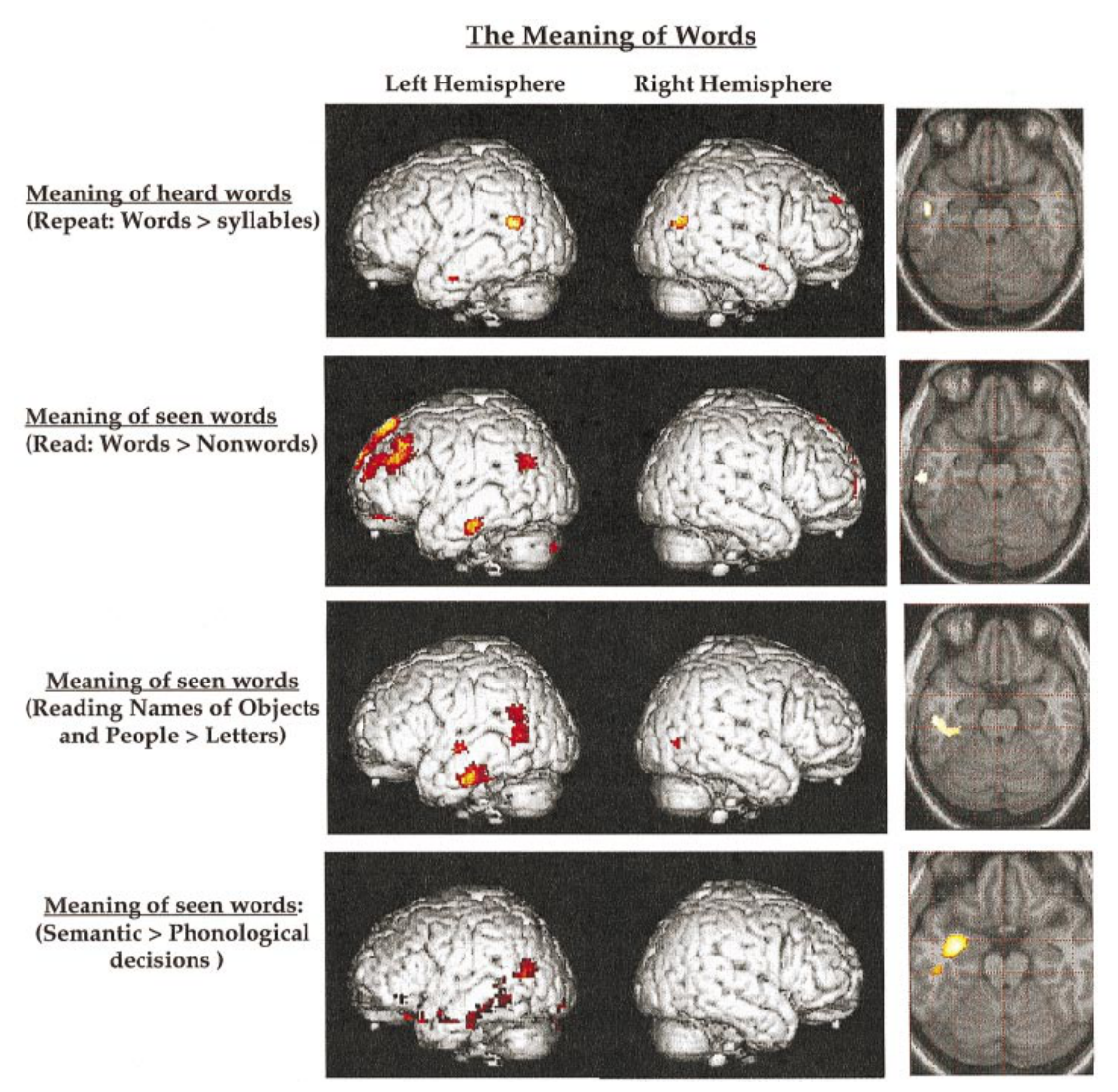
图 11 · 不同类型语义的细分
Fig. 11. Accessing different types of semantics. Areas of the brain more active for (top row) reading the names of objects relative to the names of famous people (data from Gorno-Tempini et al. 2000); second row: reading the names of famous people relative to objects (data from Gorno-Tempini et al. 1998); third row: reading sentences relative to the same list of words scrambled into a random order (data from R. Vandenberghe, A. C. Nobre, C. J. Price, unpublished); fourth row: associating a target word with 1 of 2 choices on the basis of meaning relative to physical size on the screen (data from Vandenberghe et al. 1996). On the right of each row, a transverse slice 20 mm below the intercommisural line illustrates the precise locations of the inferior temporal activations. Fifth row: transverse slices 20 mm below the intercommisural line to illustrate the relative locations of different areas in the inferior temporal lobe (data from Moore & Price, 1999 and Gorno-Tempini et al. 1998).
语义系统的内部分区:顶行显示左后中颞回对物体(及身体部位)名比对名人名更活跃(命名物体时更可能隐式提取相关动作);第二行显示前下颞叶对名人名更活跃(也可能对"语义属性更具体"这一维度敏感——语法完整的句子对乱序词亦激活此区,见第三行);第四行的语义联想任务(按意义把"Baby"连到"Cot"而非按物理大小)在颞叶与顶叶之外新增两处:中梭状回(BA20,紧邻命名区之内侧前方,跨模态响应,先天盲人读盲文抽象词也激活)与左额下、中回(含前布罗卡区)。第五行的横断面切片交代下颞叶各区的相对位置。这张图支撑结果 4 的"语义非单区"论断,也首次把前布罗卡区归入"生成词联想"——句子生产的必要环节。
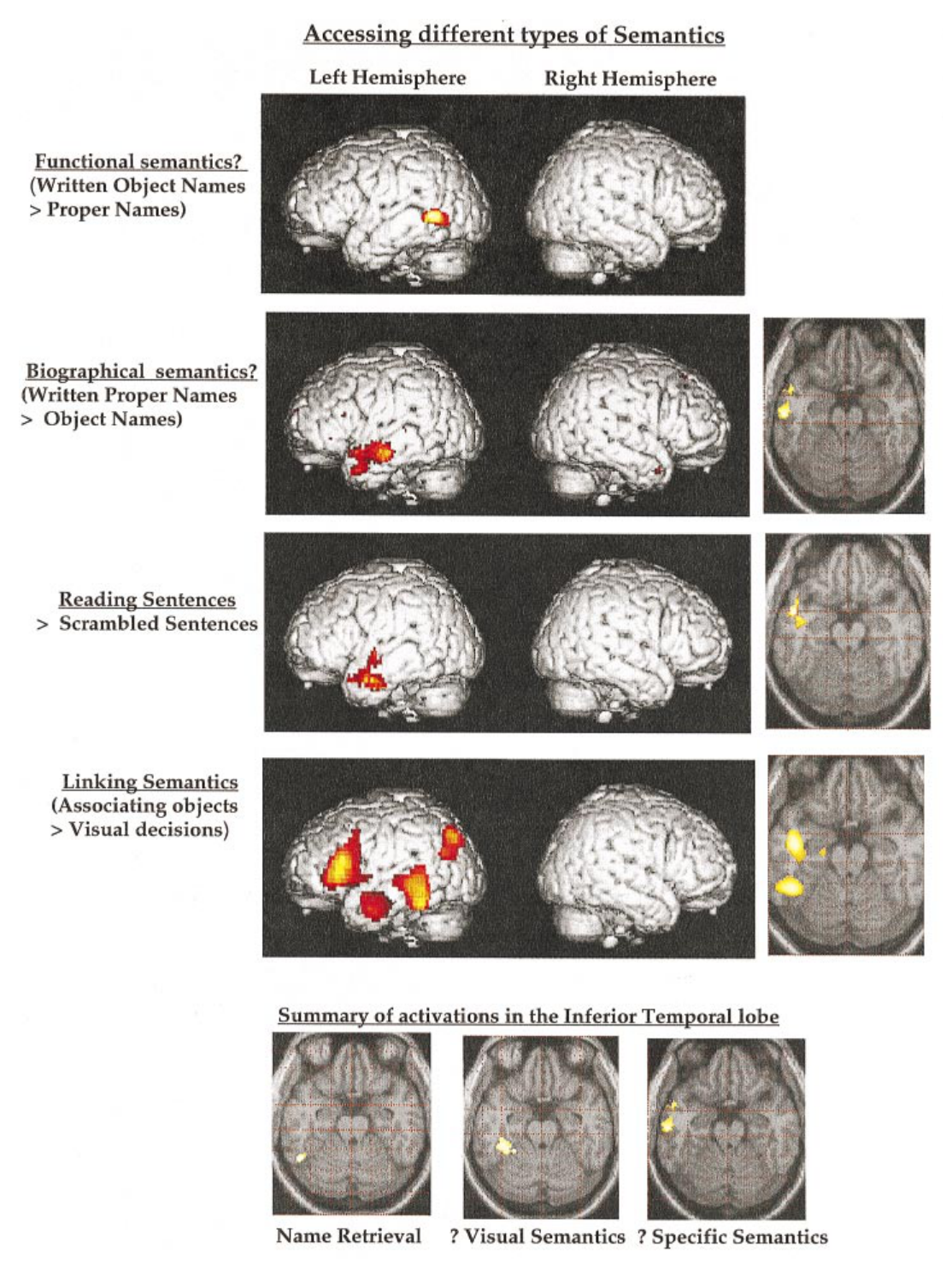
图 12 · 提出的新神经—认知模型
Fig. 12. Proposed neurological and cognitive model of language. Brain areas activated. Top row: acoustic processing of heard words and visual processing of written words (data from Price et al. 1996c). Second row, left: phonological processing of speech sounds relative to environmental sounds (data from A. L. Giraud & C. J. Price, unpublished). Second row, middle: semantic decisions relative to phonological decisions on the same words (data from Price et al. 1997b). Second row, right: retrieving the name (via lexical semantics) relative to seeing visual controls and saying 'Okay' or 'Yes' (data from Price & Friston, 1997b). Third row: transverse slices to show the anterior insula and frontal operculum activations during phonological output (data from Price & Friston, 1997b). Fourth row: motor areas for articulation and auditory processing of spoken response for reading aloud relative to reading silently (data from Price et al. 1996b). Red arrows connect these areas to indicate the proposed model of auditory and visual word processing.
全文的交付物:把前述各区按数据摆位,用红箭头连成听觉与视觉词加工的新模型。顶行是听词的声学加工与书面词的视觉加工;第二行从左到右分别是语音加工、语义加工与词汇语义介导的词提取;第三行横断面标出语音输出时的前岛叶与额叶岛盖;第四行是发音的运动区与自听反应的听觉区。它支撑结果 5,并直观呈现与图 1 的五处修正:韦尼克区的功能定位于颞上沟后部上岸、发音规划在前岛叶而非第三额回、角回改属语义系统、词义沿左下中颞叶分布、左后下颞叶补入为语义阅读通路——而 19 世纪模型真正缺的解剖件,恰恰是那些对缺血损伤相对免疫的下颞皮层。
讨论
Price 的收束方式是拿新模型与三代模型逐一对账。对 19 世纪模型:大体成立,但需五处修正(见上);模型缺的解剖区全在下颞叶——19 世纪神经学家看不到它,既因选择性损伤罕见(双重血供),也因病灶—缺陷法只能给出必要性结论。对 19 世纪模型的认知版(图 2):颞上沟后部对应"听觉词表征"、前岛叶对应"运动词表征"、外侧裂周外的颞顶区对应"概念中心"都能成立,唯独"视觉词表征"始终找不到解剖锚点——Puce 等(1994)的"字母区"坐标恰与命名区重合,提示被试其实是在默名;作者倾向于认为视觉词形功能并非定位于某一区,而是从视觉、语音、语义加工的交互中涌现。对 20 世纪认知模型:图 3 的"多条阅读通路"得到支持(经韦尼克区的非语义通路、经左后下颞叶的语义通路),但四个词特异性词典没有对应的解剖位点——这既可能是设计与分辨率问题,也可能因为这些功能本来就是交互的涌现物;作者引 Mesulam 的"每个行为由多位点表征、每个位点服务多个行为"来概括,并直言连接主义模型虽有认知 finesse 却不受生理事实约束(生理数据明确显示语音提取的解剖系统不止一套、也没有正字法输入特异的脑区)。作者承认的局限很清楚:图 12 的细节对错言之过早;8 mm 量级的解剖差异超出 PET 分辨率;全文只处理单词加工,句法组合与双语明确排除在外;右半球角色等留待行为、计算与神经生理方法的整合来回答。
一句话总结
在我看来,这篇综述真正的贡献不是给出了哪个区的"标准答案",而是示范了一种裁决程序:把两代模型翻译成可被成像数据检验的定位预言,用充分性(成像)与必要性(病灶)双向夹逼。(我的理解:它对韦尼克/布罗卡的"降级修正"——前岛叶才是发音规划的关键、韦尼克区实为颞上沟后部上岸——在随后二十年被反复验证,而"视觉词形区也许是交互的涌现物"这句当时的保守判断,后来反而成了最具争议也最有生命力的伏笔。)
审校与证据追溯 (Verification & Evidence)
图表审计结果
- Fig1: 提取质量
good,对齐度full,识别面板[] - Fig10: 提取质量
good,对齐度full,识别面板[A, C] - Fig11: 提取质量
good,对齐度full,识别面板[A, C] - Fig12: 提取质量
good,对齐度full,识别面板[A, C] - Fig2: 提取质量
good,对齐度full,识别面板[] - Fig3: 提取质量
good,对齐度full,识别面板[A] - Fig4: 提取质量
good,对齐度full,识别面板[A] - Fig5: 提取质量
good,对齐度full,识别面板[] - Fig6: 提取质量
good,对齐度full,识别面板[A, C] - Fig7: 提取质量
good,对齐度full,识别面板[] - Fig8: 提取质量
good,对齐度full,识别面板[A, C] - Fig9: 提取质量
good,对齐度full,识别面板[]
关键事实与局限性声明
- 审校纠偏: 左后下颞叶是第二条、语义性的阅读通路 -> 评注: 这是作者依据激活、病灶分布和任务差异提出的模型解释,不是直接观测事实。
- 审校纠偏: 成像与病灶证据共同证明某区域充分或必要 -> 评注: 成像提供相对激活关联;病灶结果还可能涉及邻近组织和纤维离断,均不足以建立简单的一对一因果定位。
- 审校纠偏: 阅读与复述通路存在竞争性偏置 -> 评注: 原文支持相对激活差异,但没有检验两系统之间的竞争机制。
- 审校纠偏: 相关定位在随后二十年被反复验证 -> 评注: 超出2000年原文的证据范围,且没有补充引用。
- 补充要点: 原文强调默读的激活模式会随研究、被试、词类型、呈现速度和持续时间变化;角回在部分句子阅读或慢速默读研究中激活,而不少单词默读研究不激活。
- 补充要点: 熟悉词与新奇词或假词的成像比较结果高度不一致;新奇词常同时增加所谓语义与非语义系统负荷,因此并不能干净验证双阅读通路。
- 补充要点: 左后下颞区在听词复述中并非稳定激活,而且该区损伤通常不损害复述;原文据此把其复述激活视为可能的隐性、非必要加工。
- 补充要点: 图6、图8、图10及图11的部分关键结果来自未发表数据,应在总结证据强度时明确标注。
- 补充要点: 若把该文当作单一实验记录,样本量、人口学信息和统一统计流程均不可得;它是叙述性综述,不是具有统一样本和预注册分析的研究。