该研究利用颅内场电位(intracranial field potential, IFP)技术,在 10 名癫痫患者皮层植入的 776 个电极位点上探讨了任务目标对视觉表征的神经调制动力学。研究发现,视觉刺激中是否存在当前寻找的目标类别,会显著调制腹侧视觉通路(特别是下颞回与梭状回)的神经电活动;但该调制在刺激呈现后约 250 ms 才开始显现,明显晚于早期视觉类别选择性信号(约 150 ms)。该结果在人类皮层内为自下而上的特征提取与自上而下的任务目标检测之间的时间分离提供了直接的颅内电生理证据。
研究背景
观察者所处的具体任务情境决定了相同视觉输入的行为相关性。腹侧视觉流通路的早期神经活动能够快速提供物体的类别表征,但完成目标检测任务还需要进一步将当前输入与工作记忆中的目标模板进行匹配比对。若目标存在与否能够直接改变皮层放电或场电位反应,该现象将为自上而下的注意与任务控制机制提供生理指标。关键问题不仅在于该调制在皮层内的解剖分布,更在于其激活的时间进程:目标调制是伴随最早一波感觉输入出现,还是仅在知觉表征基本确立后的晚期阶段发生。
时间进程能够检验两类处理架构:若目标调制在刺激呈现后约 150 ms 内即与感觉驱动同步出现,提示任务偏好可能早期渗透并重塑感觉前馈加工;若调制显著滞后(约 250 ms 之后),则支持分步加工模型,即皮层首先构建相对独立的客体感知表征,随后再受任务相关控制网络的作用。颅内场电位记录兼具解剖局部性与毫秒级时间分辨率,但为了排除眼动微跳、按键动作准备以及大范围容积传导引起的假象,需要在物理刺激完全相同的条件下进行任务对比,并辅以局部导联分析。
Bansal 等采用区块设计预设目标类别,使相同图像交替出现在目标存在与目标缺失试次中,比对 776 个电极在宽带与各频段的局部场电位反应,并结合单试次机器学习解码分析各区域目标信息的出现潜伏期。研究旨在分析:任务目标调制主要分布在哪些视皮层与额顶区域、其神经调制的起始时间节点,以及它与局部视觉选择性响应在动力学上是否可分。
研究思路
研究设计通过控制实验流程解耦了物理输入与任务目标:在每个实验区块开始时指定一个目标类别(动物、汽车、椅子、面孔或房屋),随后快速呈现 100 ms 的图像(包含单物体或双物体组合),被试仅需按键报告图像中是否包含预设的目标类别。由于物理上完全相同的测试图像既可出现在目标存在试次,亦可出现在目标缺失试次,两类条件之间的生理反应差异可归因于自上而下的任务状态,而非图像底层的物理特征差异。
在此基础上,分析分为三个层次展开:首先,在宽带和不同频段分别定义表现出目标显著调制的电极,并采用双极导联检验其局部起源;其次,比较目标调制的出现潜伏期与既往确立的早期视觉选择性时程,评估自下而上识别与自上而下检测的时序差;最后,采用单试次线性判别分析(LDA)在各脑区伪群体水平评估目标信息的时间演化,并通过眼动追踪与按键反应对齐检验,系统排除扫视与运动准备成分。
方法
被试为 10 名药物难治性癫痫患者(7 女 3 男,8 名右利手,年龄 10.3–46.5 岁),接受开颅硬膜下电极植入评估,共记录 776 个电极位点。信号以 256 Hz 或 500 Hz 采样,经 60 Hz 陷波与 0.1–100 Hz 带通滤波。通过个体术前 MRI、术后 CT 配准并结合 FreeSurfer 图谱,将电极精确定位至 75 个皮层亚区。行为测试每个区块 50 试次,人均完成 1134.8±430.3 试次;平均反应正确率为 92±7%,反应时为 775±299 ms;后续分析均基于正确试次,分析时间窗为刺激呈现后 0–600 ms。
电极被判为“目标调制”需满足双重准则:一是目标存在与缺失试次的 IFP 波形存在显著差异(双侧 t 检验 p < 0.01)且该差异同向持续至少 70 ms(经随机置换校准,假阳性发现率 FDR 约为 1%);二是两条件峰值电压差不低于 28.8 µV(约为噪声基线的 2 倍)。频域分析采用三阶 Butterworth 滤波器将信号分解为宽带(0.1–100 Hz)以及 0.1–4、4–8、8–12、12–35、35–50、70–100 Hz(gamma 频带)六个子频段,提取解析信号包络。单试次解码采用线性判别分析(LDA),在电极数 ≥20 的脑区内构建跨被试伪群体,采用留一交叉验证评估分类性能。
主要结果
- 目标调制广泛存在且呈空间局部性:在精确定位的 744 个电极中,94 个(12.6%)显示出宽带目标调制,其中 78 个位于非运动皮层,61 个在双极导联下保持显著。下颞回示例电极显示,自刺激呈现后 212 ms 起目标存在试次的 IFP 幅度显著增大(p < 10^-14),且该调制在不同物体类别、物体数量及呈现位置下均稳定存在;相邻 1–2 cm 的电极未记录到同类反应,排除了容积传导伪影(图 2–4)。
- 调制效应在高级物体识别相关脑区富集:宽带调制电极比例最高的区域依次为梭状回(37.5%)、缘上回、海马旁回、下颞回及额中回(表 1、图 7);在 gamma 频带(70–100 Hz)中,调制比例最高的区域为枕下回(44.4%)、梭状回、上顶回、额中回与缘上回。额叶部分区域亦检出目标调制,但表现更为延迟。
- gamma 频段以功率增强为主,与宽带调制部分分离:76 个电极(10.2%)在 gamma 频带表现出目标调制,与 94 个宽带调制电极仅有 27 个重叠(35.5%)。在调制方向上,宽带与低频带信号中反应增大与减小的电极各占约一半;而在 gamma 频带,约 76% 的调制电极表现为目标存在时的功率显著升高(双侧符号检验 p = 1.9×10^-5)(图 5、6)。
- 目标调制潜伏期系统性滞后于视觉识别信号:宽带信号的目标调制平均潜伏期为 377.0±11.6 ms,gamma 频段为 383.7±13.8 ms,各脑区间潜伏期差异未达统计显著;综合多项分析,目标调制效应的起始时间均落在刺激呈现后 250 ms 之后(图 8)。该时间点相较于该区域已知的视觉类别选择性信号(刺激后约 150 ms)延迟了 100–150 ms,同时显著早于按键平均反应时(775 ms)。
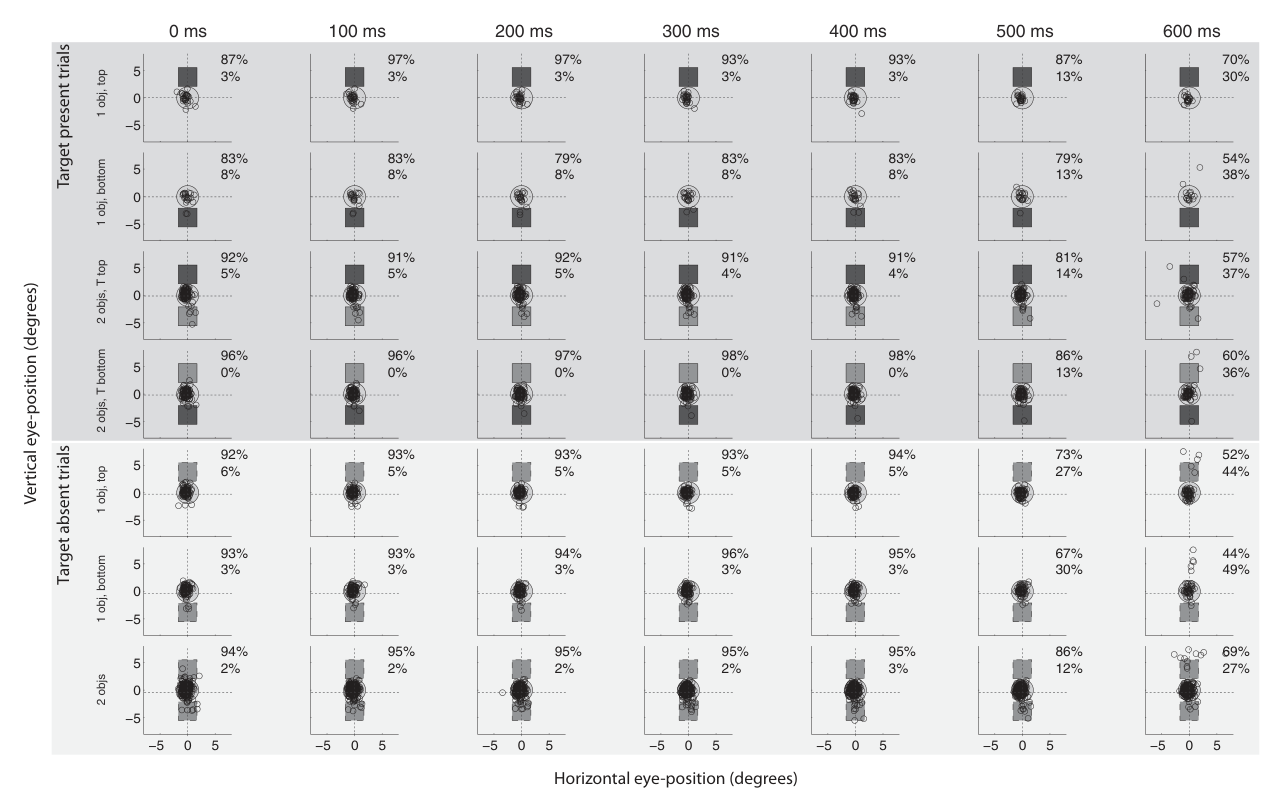
- 单试次可精确解码目标存在状态,各区域动力学存在差异:基于宽带信号的解码分析显示,下颞回解码性能最早达到显著(约 275 ms)且在 600 ms 时达到最高准确率(77.4%),梭状回(约 350 ms,69.7%)与缘上回(约 400 ms,71.3%)次之;gamma 信号解码中,梭状回表现出最早的显著性(约 350 ms,69.8%)(图 9)。同步眼动追踪证实两类试次间的注视轨迹无统计学差异(图 10),且神经电位与刺激呈现 onset 的对齐度明显优于与按键反应的对齐度,排除了扫视与运动准备解释。
图注解读
图 1 · 实验设计与行为表现
原文图注:Figure1. Experiment description and behavioral performance. A, Each block of 50 trials started with a screen indicating one of five target categories (Animal, Car, Chair, Face, or House). Each trial consisted of image presentation for 100 ms followed by subject response. The image contained one or two objects presented above and/or below the fixation spot (see top left inset). There were 25 possible objects, 5 per category. In 1/3 of the trials the target category for that block was present. Subjects had 1000 ms (subjects 1–3) or unlimited time (subjects 4–10) to respond. The response was either a button press only when target was present (subjects 1–3), or two distinct buttons for target present versus target absent (subjects4–10)……
这张图是全文的任务说明书。A 面板画出试次结构:先提示目标类别,再闪现 100 ms 图像(物体在注视点上方/下方),然后被试报告;B 面板给出每名被试对目标出现(黑)与缺失(灰)试次的正确率,全体平均 92±7%,远高于随机水平;C 面板给出各类别的平均反应时,全体平均 775±299 ms。它支撑的是"任务简单、被试认真执行"这一前提,也是后文只分析正确试次的基础。
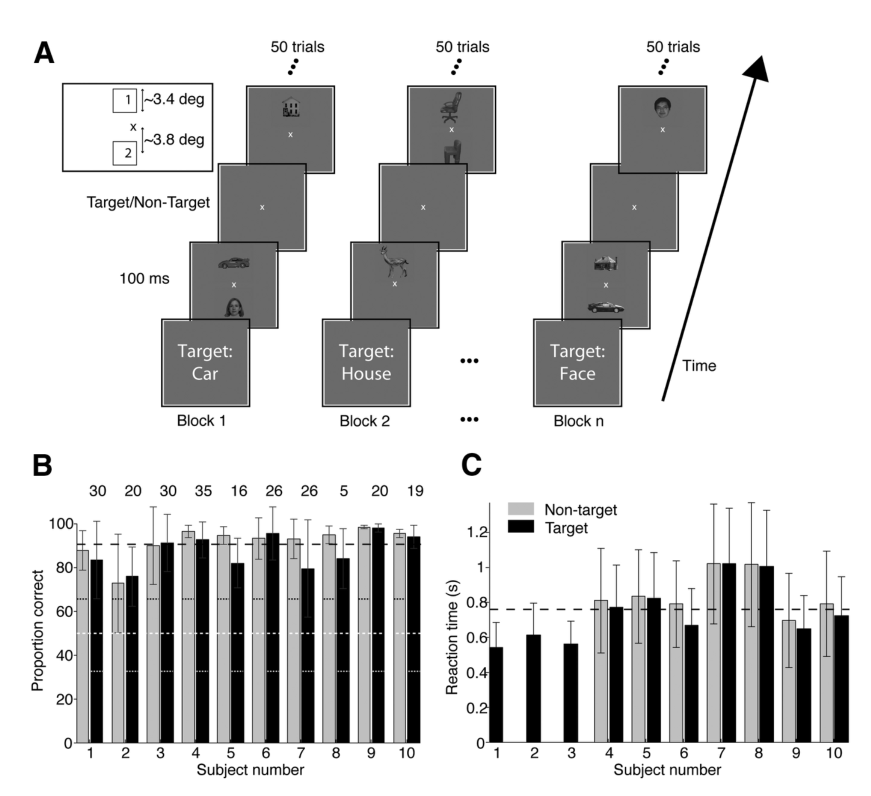
图 2 · 例电极一:下颞回的目标调制
原文图注:Figure 2. Example electrode showing differential responses between target present and target absent trials. A, Example IFP responses from an electrode located in the inferior temporal gyrus (Talairach coordinates [46.2,3.8,39.1], see G) to three individual images containing object pairs eliciting strong, moderate, or weak modulation (black, target present; gray, target absent). B, Average responses from the same electrode in the presence (black, n = 485 trials) or absence (gray, n = 1015 trials) of the target.……
这是核心现象的示范。A 面板展示单个图像诱发的原始波形,目标出现(黑)与缺失(灰)即使在单试次层面也可见差异;B 面板给出平均波形,从约 212 ms 起黑色曲线在灰色之上,粗黑横杠标记统计显著时段;C–E 面板用双极导联、按目标类别、按物体数量分组复验;F 面板显示目标在上/下位置均有调制;G、H 面板是关键的对照——同片相邻电极无此效应。它支撑结果 1:调制真实、与具体刺激属性无关、空间上局部。
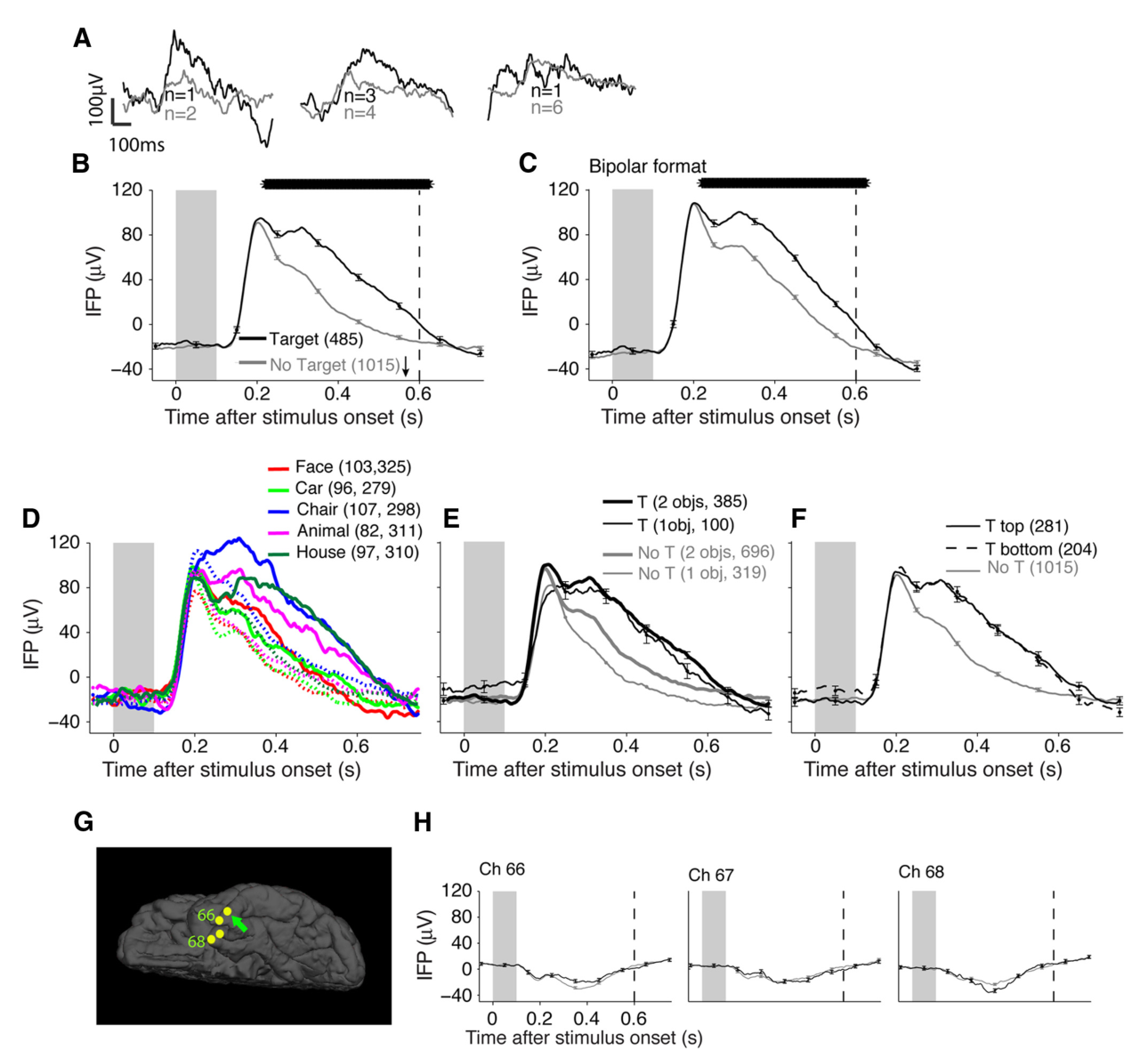
图 3 · 例电极二:梭状回的镜像现象
原文图注:Figure 3. Second example electrode. Responses from a second example electrode located in the left fusiform gyrus (Talairach coordinates [29.8,43.1 17.3]). The format and conventions are as in Figure 2. A, Average responses from the same electrode in the presence (black, n = 303 trials) or absence (gray, n = 697 trials) of the target. B, The same responses are shown in a bipolar montage. C, The same responses are plotted separately for each of the five categories. D, Responses separated based on whether the image contained one object (thin lines) or two objects (thick lines). E, Responses separated based on whether the target was in the top (solid line) or bottom (dashed line) position. F, Electrode location (arrow) and location of seven other electrodes on the same strip. G, Responses from the other seven electrodes on the same strip (format as in A).
第二例电极位于左梭状回,与图 2 互为印证,但方向相反:目标出现试次的平均 IFP 显著更负,且五个类别全部显著。单/双物体、上/下位置的分组以及邻近电极对照的结论同图 2。它说明目标调制不是某个电极的偶然现象,在腹侧流的另一关键区域以另一种极性同样成立。
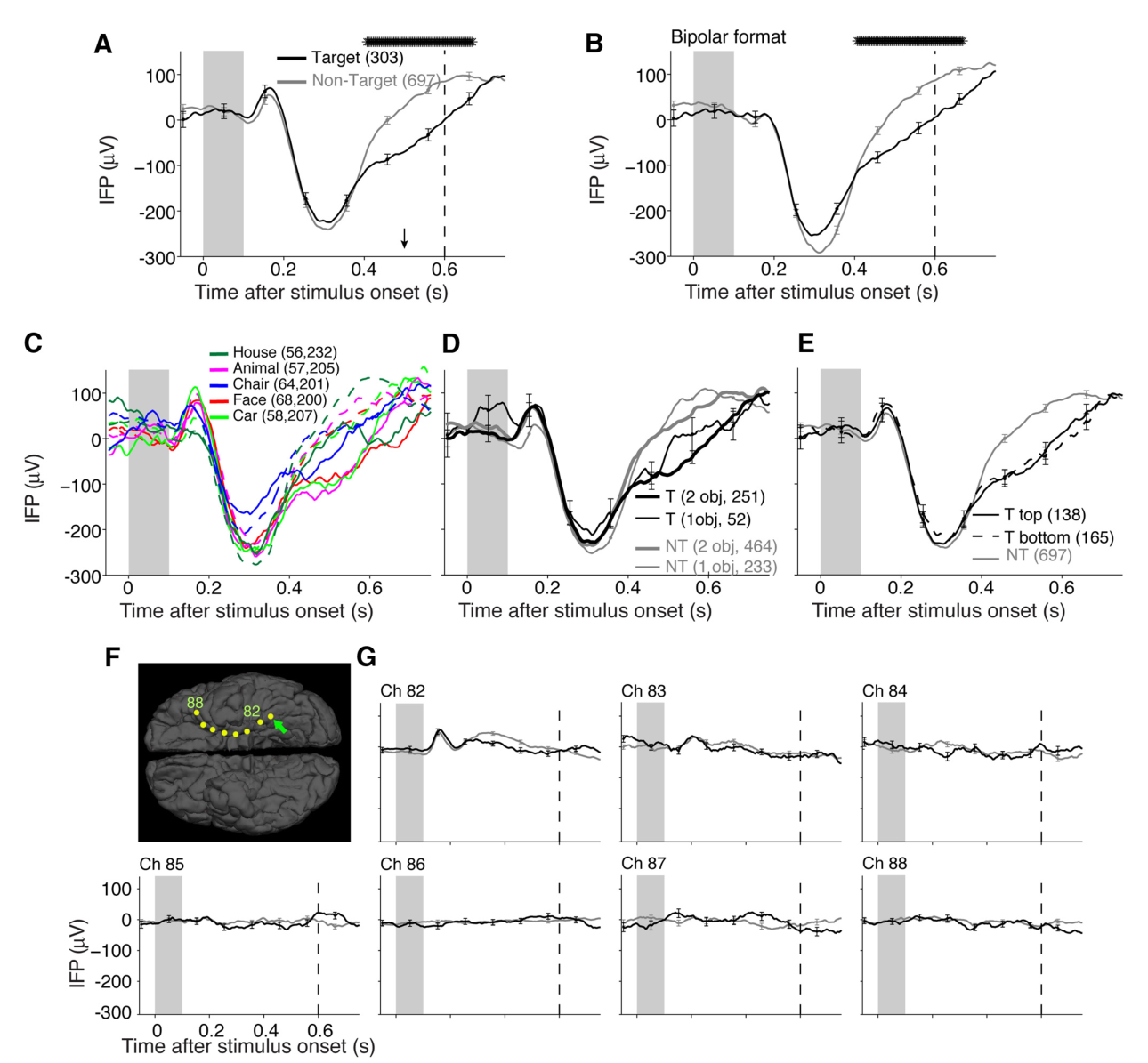
图 4 · 全部调制电极的平均反应
原文图注:Figure4. Responses of all target-modulated electrodes. Mean (±SEM) IFP responses, normalized by dividing by the maximum voltage, for target present (black) versus target absent (gray) trials for all the non-motor electrodes that showed target modulation in correct trials. The baseline IFP response (mean IFP between 50 and 0 ms before stimulus onset) was subtracted from each electrode's mean IFP response. Negative voltage responses (e.g., Fig.3B) were reflected with respect to the y-axis before normalization…… A, Electrodes above the diagonal in Figure 6A (n = 56, where power in target present trials > power in target absent trials). B, Electrodes below the diagonal in Figure 6A (n = 22, where power in target present trials < power in target absent trials)……
这张图把 78 个非运动区调制电极的波形叠画在一起:A 面板是目标出现时反应增大的 56 个电极,B 面板是减小的 22 个电极。所有曲线先减基线、再除以最大值归一化,负向反应先对 y 轴取镜像以便平均。它直观呈现结果 1 的群体层面:无论调制方向如何,差异都集中在视觉诱发响应之后的时段,而且增、减两类电极都真实存在——这也是后文讨论宽带信号调制方向不定的伏笔。
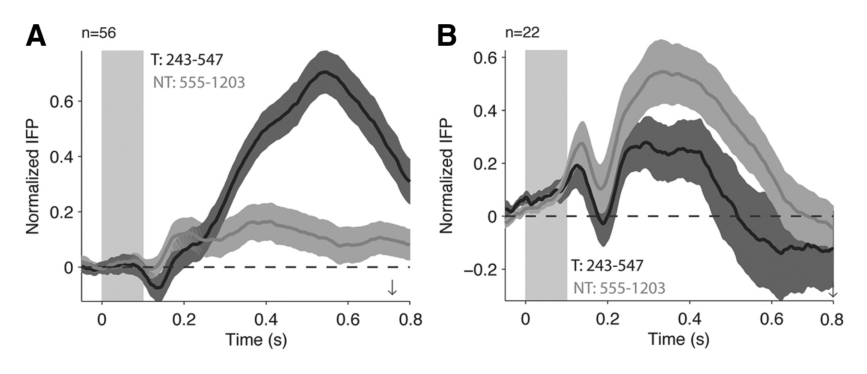
图 5 · gamma 频带的例电极
原文图注:Figure 5. Example electrodes showing differential responses between target present and target absent trials in the gamma frequency band. Three example electrodes located in the inferior temporal gyrus (A, Talairach coordinates [57.4 8.5 10.9]), inferior occipital gyrus (B, [49,84.5,1.4]), and fusiform gyrus (C, [48.6,32.6,9.2]) showing responses in the gamma frequency band during target present (black) and target absent (gray) trials. The format and conventions follow those in Figure 2B except that here the y-axis represents the envelope of the IFP signal in the 70–100 Hz frequency band (see Materials and Methods). The mean reaction time (arrow) in A and C was after 800 ms.
格式与图 2B 相同,只是纵轴换成了 70–100 Hz 信号的包络。三个例电极(下颞回、枕下回、梭状回)都在目标出现试次表现出 gamma 功率的升高。它支撑结果 3 的"现象存在"一面:gamma 带调制可重复,且鉴于 gamma 功率常被视为与神经元放电活动相关,这提示目标检测伴随局部加工的增强。
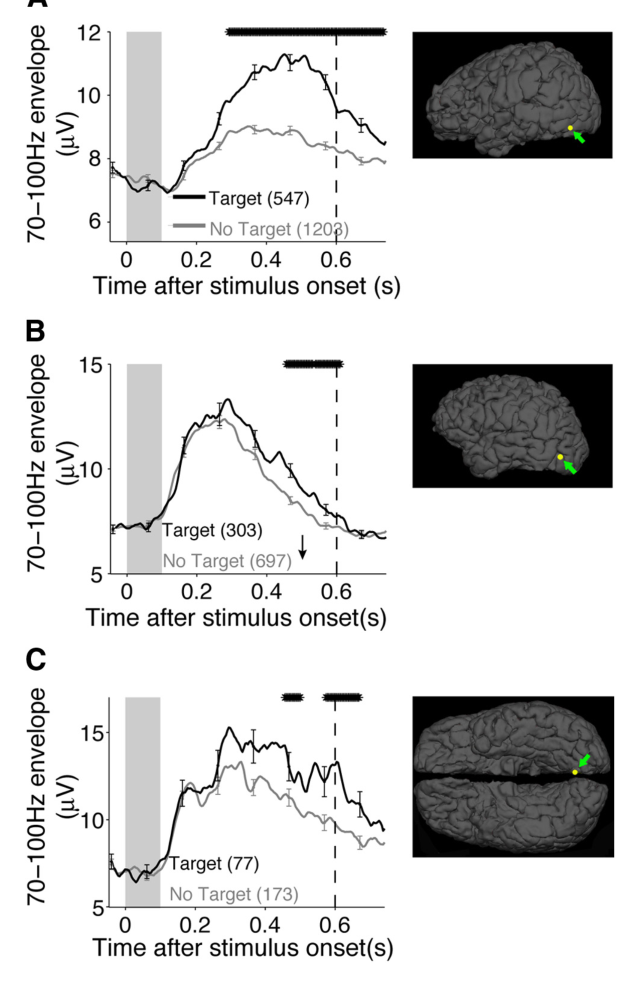
图 6 · 七个频带的调制方向比较
原文图注:Figure 6. Comparison of responses for target present versus target absent trials in seven frequency bands. Normalized root-mean squared power (average response from 200 to 550 ms after stimulus onset, normalized by the maximum value) for broadband signals (A) and six different frequency bands (B–G) in target present trials (y-axis) versus target absent trials (x-axis). Each circle denotes a separate electrode that showed target modulation. Error bars indicate 1SEM. The diagonal line represents equal response for target present and target absent trials. A two-sided sign test determined significant asymmetry in the distribution of the points across the diagonal for the 4–8, 8–12, 35–50, and 70–100 Hz bands……
这是结果 3 的定量核心。每个频带一幅散点图:横轴为目标缺失试次的归一化功率,纵轴为目标出现试次的功率,对角线代表两者相等;点落在对角线上方即目标出现时功率更大。宽带(A)与低频带(B)的点均匀分布在对角线两侧,而 70–100 Hz(G)中约 76% 的点在上方(符号检验 p=1.9×10^-5)。"x"标记来自打乱试次标签的对照,给出随机偏离对角线的期望幅度。这张图确立了"宽带增减各半、gamma 以增强为主"的关键对比。
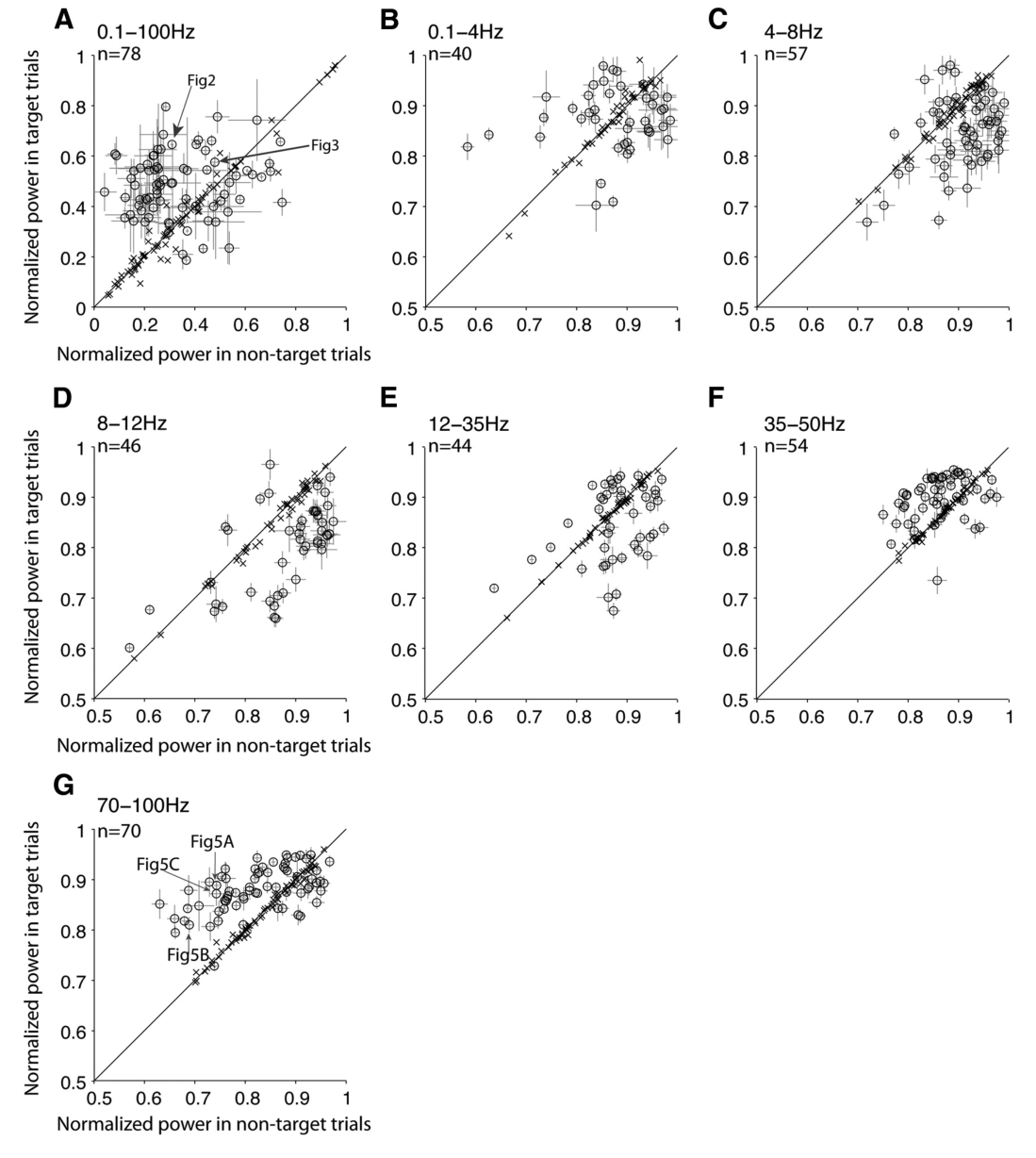
图 7 · 调制电极的解剖分布
原文图注:Figure 7. Electrode locations. Lateral view showing the location of sampled electrodes (black), electrodes in regions that showed modulation by target presence in both broadband and gamma band signals (yellow), electrodes in regions that showed modulation by target presence predominantly in broadband signals (blue), and electrodes in regions that showed modulation by target presence predominantly in gamma band signals (red). Only regions with 5 electrodes showing target modulation are shown in this figure (Table 1). All electrodes were mapped onto one subject's brain (subject 10) and reflected onto the left hemisphere for this illustration.
把所有电极投影到同一被试(被试 10)的左半球侧视图上:黑色为采样电极,黄色为宽带与 gamma 双重调制的区域,蓝色为以宽带调制为主的区域,红色为以 gamma 调制为主的区域。它支撑结果 2:调制集中在腹侧视觉流(梭状回、下颞回)及顶叶、前额叶的相关区域,且不同区域在频带偏好上有所分化——例如下颞回偏宽带、上顶回与枕下回偏 gamma。
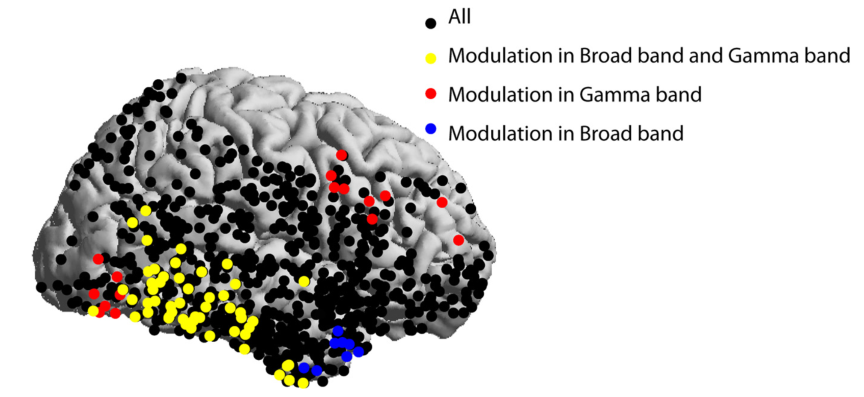
图 8 · 调制延迟的分布
原文图注:Figure 8. Differentiation between target present and target absent responses started after 250 ms poststimulus onset. For each electrode that showed a differential response between target present and target absent trials, we defined the target modulation latency as the first time point when a two-tailed t test between target present and target absent trials yielded p < 0.01 for at least 70 consecutive ms (FDR < 0.01; see Materials and Methods). The plots show the distribution of latencies using the broadband power (A, n = 78 electrodes) or the gamma power (B, n = 70 electrodes). The inverted triangles indicate the mean. The arrowheads indicate the examples from Figures 2, 3, and 5. Bin size = 50 ms. C, D, Mean (±SEM) target modulation latency in each region……
A、B 两面板分别是宽带与 gamma 带的延迟直方图:分布从约 250 ms 之后才展开,均值分别约 377 与 384 ms(倒三角标记),最早也晚于视觉选择性响应的出现时间;箭头标出图 2、3、5 中例电极的位置。C、D 按区域给出平均延迟,各区差异未达显著。它支撑结果 4——本文最核心的数字:目标调制晚于识别信号约 100–150 ms。
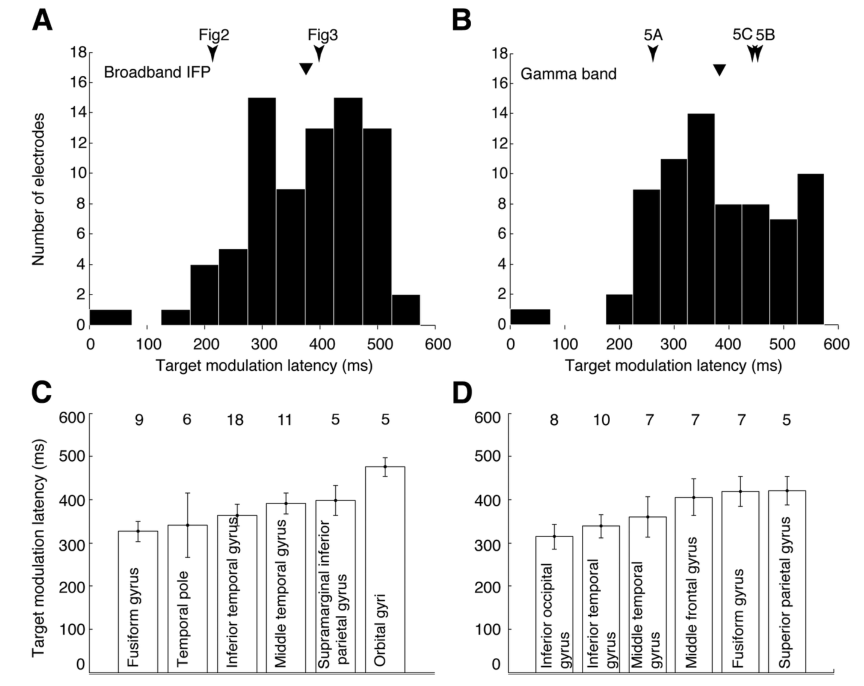
图 9 · 单试次解码的时间进程
原文图注:Figure 9. Single-trial discrimination between target present and target absent trials. Decoding performance using the best 20 electrodes (A, B) or 20 random electrodes (C, D) in each of 10 regions with at least 20 sampled electrodes across nine subjects (see Materials and Methods). A linear discriminant analysis classifier was used to decode whether the target was present or absent in any given trial. At each time point t on the x-axis, the broadband (A, C), or gamma band (B, D) signals in the interval [50,t] ms were used for classification. The classification performance reported on the y-axis is obtained from cross-validated test data. Error bars indicate 3 SEM. The 20 best electrodes were selected using only training data. The gray shaded region indicates chance levels……
纵轴是交叉验证的解码正确率(50% 为随机),横轴是用于分类的数据窗口右端点 t;A、C 用宽带,B、D 用 gamma;A、B 用每区域最好的 20 个电极,C、D 用随机 20 个电极以校正采样偏倚。下颞回在宽带下最早显著(约 275 ms)且 600 ms 时达 77.4%,梭状回在 gamma 下最早(约 350 ms,69.8%)。它支撑结果 5:目标信息在单试次层面可读出,且不同区域的解码起始与强度构成一个候选的加工层级。
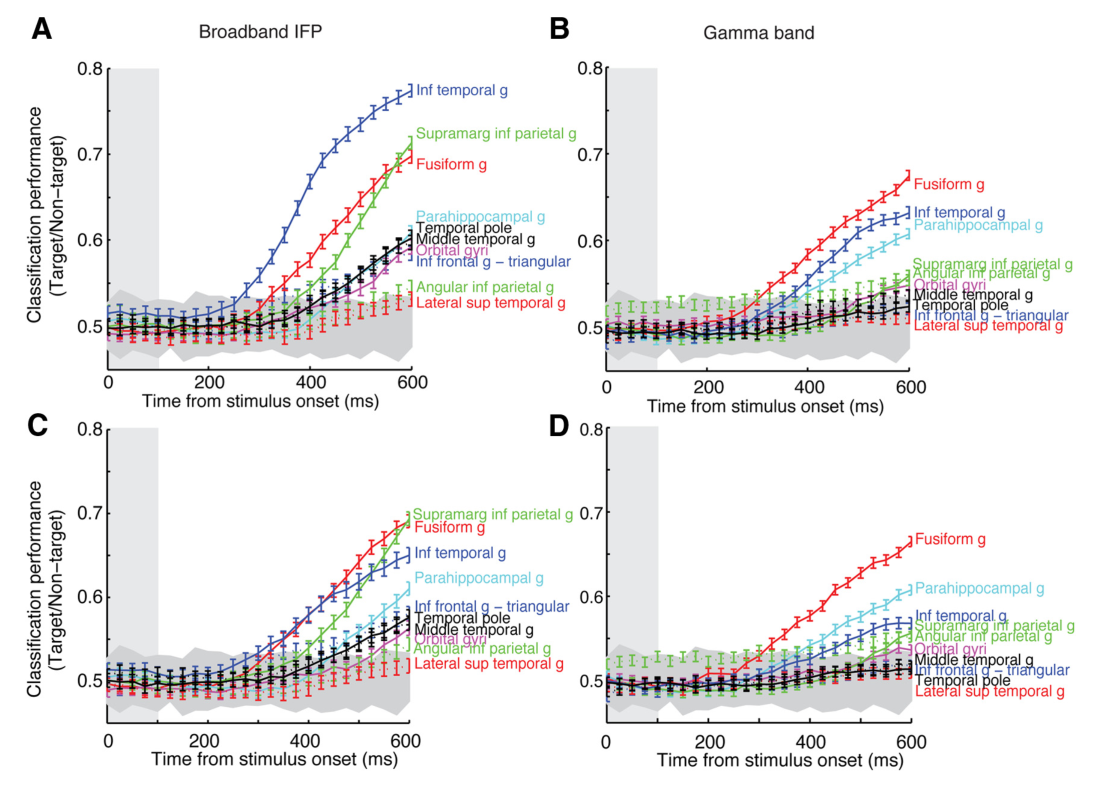
图 10 · 眼动对照
原文图注:Figure 10. Eye position was similar in target present and target absent trials. Eye position as a function of time from stimulus onset for subject 10. Each small circle denotes the eye positions (horizontal in x-axis and vertical in y-axis) during each trial in 100 ms intervals from the time of stimulus onset (first column) to 600 ms after stimulus onset (seventh column). The top four rows represent target present trials. The top two rows represent trials where only one object was presented (dark gray squares represent target location) above (row1) or below (row2) the fixation point……
这是排除解释的关键对照。每格是某一时段内所有试次的眼位散点(横轴水平眼位、纵轴垂直眼位),上四行为目标出现试次(按物体数与目标位置分组),第 5–7 行为目标缺失试次;大方圈是半径 2° 的注视窗。格内数字给出注视落在窗内的试次比例:刺激后前 500 ms 内绝大多数试次保持在注视窗内,且目标出现与缺失试次之间无系统差异。它支撑结果 5 中排除眼动解释的那一半。
讨论
作者将主要发现概括为阶段分离的神经动力学模型:早期自下而上的感觉响应在刺激呈现后 150 ms 内完成特征解码,而包含任务目标判断的晚期自上而下调制则在约 250 ms 之后显现,两者相差约 100–150 ms。这一时延范围与此前猕猴在视觉搜索任务中单细胞记录所见模式(Chelazzi 等,1993/1998/2001)相呼应——在该范式中,目标偏好对单神经元放电的调制同样较最初的感觉选择性晚约 100 ms。作者推测,该晚期调制可能源自额顶注意控制网络经由基于特征的注意(feature-based attention)施加的反馈,因为本实验中目标位置在视野内随机呈现,空间注意无法提前聚焦。
作者亦指出了该研究的局限性:临床电极植入的覆盖范围受限,当前数据尚无法确认目标调制的发源区域;尽管非运动区定位、空间局部性、同侧半球调制及刺激锁定分析均支持感觉皮层调节假说,但仍需谨慎与晚期决策变量或精细运动预备相区分;此外,各脑区之间调制的统计潜伏期未达到显著性差异,可能受限于区域采样电极数量。关于频带分异,作者提出宽带电位可能综合反映了大范围突触后电位的总和,而 gamma 频段的功率升高则指示了局部抑制性神经元网络参与的密集计算,为理解人类下颞皮层受任务自上而下调节提供了电生理学依据。
一句话总结
该颅内电生理研究表明,人类腹侧视觉通路中的目标检测调制发生在刺激呈现后约 250 ms 之后,系统性滞后于约 150 ms 的早期客体识别信号,揭示了高级视觉皮层从感觉特征表征向任务目标整合推进的时间动态过程。